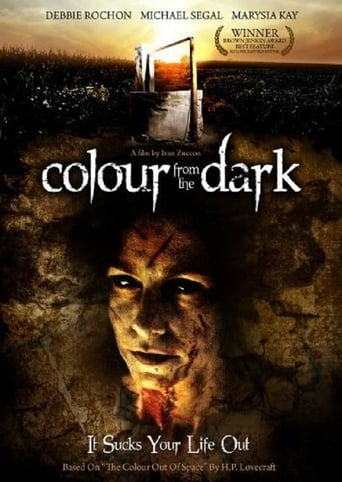
Colour from the Dark
4.8(21 votes)
1h 32mOctober 19, 2008Overview
Pietro and Lucia live on an isolated farm with Alice, Lucia's younger sister. Poor farmers, they live tilling the soil. Pietro is a good worker and a strong man who, unlike his three brothers, is not at war because of a deformed knee. Lucia is a beautiful and reserved woman dedicated to her family. Their life is peaceful and good, in spite of the hard work. One day, while drawing water from the well, Pietro and Alice accidentally free something from Earth's womb. A strange and alien color flashes underwater, at the well's bottom, then disappears. From that moment on, inexplicable events start happening all around the farm, and by night the surrounding vegetation glitters with a sinister glow. The color soon takes hold of the whole farm, and dwelling inside Pietro and his family's minds, it brings them into its sick world of pain, blood and death.
Cast
Debbie Rochon
Lucia
Michael Segal
Pietro
Marysia Kay
Alice
Alessandra Guerzoni
Teresa
Eleanor James
Anna
Matteo Tosi
Father Mario
Emmett J. Scanlan
Luigi
Key Crew
Director
Ivan Zuccon
Writers
H.P. Lovecraft, Ivo GazzarriniProducer
Ivan ZucconMusic
Marco Werba
More Insights
Curator's Notes
Colour from the Dark is a faithful and atmospheric adaptation of Lovecraft’s The Colour Out of Space, set in a WWII-era Italian farmhouse. It juxtaposes cosmic alien terror with historical human atrocity, offering a meditation on madness, decay, and the limits of belief. Though modest in budget, its creeping dread, symbolic imagery, and tragic tone make it a compelling chapter in contemporary Italian horror and Lovecraftian cinema.
Awards & Recognition
While praised by outlets like Bloody Disgusting for capturing Lovecraft’s oppressive atmosphere, others highlight its uneven pacing and limited budget. It holds a middling IMDb score around 4.8/10.
Background
Colour from the Dark is a 2008 Italian horror film directed by Ivan Zuccon, adapting H.P. Lovecraft’s short story “The Colour Out of Space.” Set in rural Italy during World War II, it stars Michael Segal as Pietro, Debbie Rochon as Lucia, and Marysia Kay as Alice. Pietro, a farmer, lives with his wife Lucia and her mute younger sister Alice. One day, while tending their well, they inadvertently unearth an eerie, phosphorescent color. Strange phenomena follow—crops grow and decay unnaturally—but soon, the color drains life and sanity from all who encounter it.
Setting and Cinematic Tone
Zuccon, who also handled cinematography and editing, created a distinctive mood via unsettling camera movement, dreamlike sequences, and minimal CGI. The score by Marco Werba enhances the unsettling tone. This gradual breakdown of body and mind echoes Lovecraft’s exploration of madness in the face of incomprehensible forces.
Cultural Reference
1. Lovecraftian Horror in an Italian Setting: This film transposes Lovecraft’s classic New England tale into Italy, retaining the core cosmic horror while grounding it in regional history. 2. War, Fascism & Allegory: By placing the story in WWII-era Italy, the filmmaker infuses real-world dread. The alien color becomes a metaphor for invading, irrepressible evil—paralleling the rise of fascism. 3. Religious Symbolism & Anti‑Logic: Italy’s Catholic backdrop features prominently—crucifixes and faith repeatedly fail. In Lovecraftian logic, supernatural corruption defeats religious moral structures, suggesting human spirituality is powerless against cosmic horror.